
If I Wanted to Open a Sanso in the Alps Today, Could I?
If you’re anything like me, you’ve probably passed a mountain hut and wondered at some point: what would it actually take to run one of these myself? Buy a mountain plot somewhere, put up four walls and a stove, spend the warmer months handing out futons and bowls of curry to weary hikers, and take the other half of the year off.
It’s a nice fantasy. It’s also, as it turns out, one of the more instructive rabbit holes I’ve gone down in a while, because it opens onto a much stranger and more interesting question: how did anyone else manage it, and who actually owns the ground these places are standing on?
The Short Answer: No
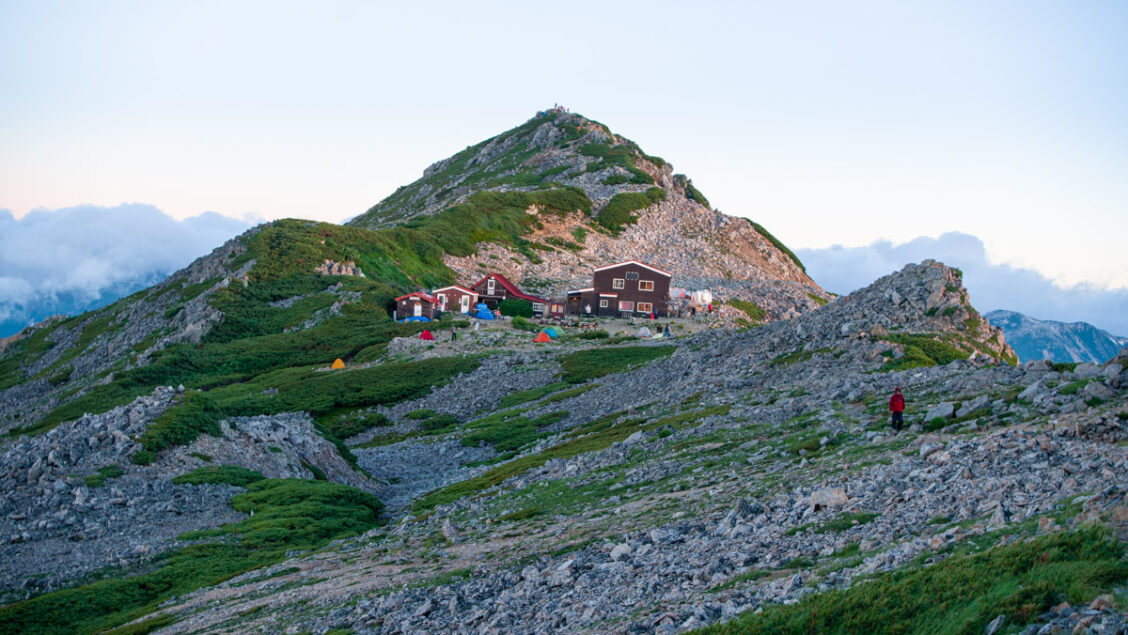
And this isn’t simply a theoretical difficulty. I couldn’t find a single example from recent decades of a completely new mountain hut being permitted on a site where there had previously been none. The most recent example I could find was Kumo-no-daira sanso, whose present building was constructed by its founder in 1963. According to its current operator (who happens to be the founder’s son), the huts now operating in the Southern Alps trace their origins to people who established them in the postwar period, with the businesses subsequently passed down through generations. The “new” huts of more recent times turn out to be rebuilds, replacements, or revivals of existing hut sites rather than genuinely new operations.
A large proportion of hut sites in the Japanese Alps sit inside one, or often both, of two overlapping regulatory spaces:
National Parks: Governed by the Natural Parks Act under the Ministry of the Environment (or prefectural governments), where strict Special Protection Zones severely restrict new construction.
National Forest Land: Administered by the Forestry Agency, where new construction or occupation requires formal land-use approval, such as a lease or usage permit.
Plenty of huts are subject to both systems simultaneously. In the strictest zones, permission for new construction is handled at the national level. The practical reality is that you cannot simply find an attractive patch of mountainside and apply to build a brand-new sanso.
While many sites are on national land, others sit on prefectural land or privately owned corporate forestry land, such as the large swathes of the Southern Alps owned by Tokai Forest’s parent company. Securing all necessary environmental clearances and land-use rights makes building a new hut from scratch today an extremely difficult proposition.
The realistic way in, according to industry accounts, is much less romantic: work at an existing hut for years, build relationships within the surrounding community, and eventually take over the business or operating rights from the retiring owner.
Which is exactly where the story gets interesting.
So How Did the Existing Ones Get Built?
Mostly, it comes down to timing. A large number of huts in the Alps date from the late Meiji or Taisho eras long before modern national park and national forest regulatory frameworks existed or during a period when enforcement was vastly different.
Hakuba-sanso is a prime example. Its origins trace back to 1905, when local mountain enthusiasts secured usage rights for an old military survey shelter near the summit of Mt. Shirouma (Hakuba) and converted it into a lodge the following year. It quite literally began life as army surplus. By the time national forest and park designations were established along that ridge, the hut was already a recognised fixture.
That pattern repeats across much of the Japanese Alps: the building and its use predated the regulations that would now govern new construction, leaving later generations to maintain, alter, and operate an established facility rather than having to start from scratch.
Are They Privately Owned, and Who Owns the Land?
The structures and the businesses are often privately owned, multi-generational family operations. The ground underneath, however, is an entirely different matter.
Huts in national parks or on national forest land operate under long-term lease arrangements with government authorities rather than owning the real estate outright. In the Southern Alps, Tokai Forest operates mountain huts on forest land owned by its parent company, Tokushu Tokai Paper Co., Ltd.
In short, there is no single ownership model. Some operators own the underlying land, others lease government-owned land, and the business entity itself is often legally distinct from both.
This distinction has led to high-stakes legal battles. Mitsumata-sanso, located deep in the Northern Alps near the Kurobe River headwaters, was at the centre of a decades-long legal dispute over land rent with the Forestry Agency. The agency sought to shift lease calculations from a flat annual fee to a revenue-indexed formula requiring huts to pay 1–3% of their gross turnover. After years of litigation, the courts ultimately upheld the Forestry Agency’s revenue-based calculation method, a striking illustration that even long-established huts can remain subject to complex public land arrangements
On the succession front, however, old sites can find second lives. Reisen-goya, on the flanks of Mt. Norikura, closed in 2006 after 75 years of operation. Sixteen years later, in July 2022, it reopened following an extensive renovation under a new operator. Even a hut that has been shut for over a decade can be brought back to life rather than disappearing entirely.
What Happens When a Hut Closes for Good?
On paper, Forestry Agency leases can require the operator to restore the site to its original condition when the lease ends.
In practice, dismantling a substantial structure deep in the backcountry is logistically complex and expensive. As a result, abandoned huts often linger for years:
Gan-toge (Okuchichibu Mountains): Abandoned for years near Mt. Kasatori, this structure is now in complete disrepair, a ruin slowly being reclaimed by the forest.
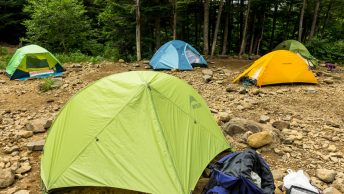
Okutama-goya (Mt. Kumotori): A clean counterexample. After closing in March 2019, the structure was completely cleared, paving the way for the new Gojunin-daira campsite development on the same footprint.
Fujimi-sanso (Daibosatsu Area): Positioned along the trail between Fukuchan-so and Daibosatsu-toge, this lodge simply ceased operations and has stood shuttered beside the trail ever since, largely ignored by passing day-hikers.
The Fantasy, Revisited
Could you open a sanso in the Japanese Alps today? Not from scratch. The land was spoken for generations ago, tightly bound by overlapping environmental protection laws and state land leases.
The only practical path forward is to immerse yourself in the existing network: work the seasons, learn the logistics of high-altitude supply chains, and eventually take over an established operation.
And if a hut eventually closes without a successor? Some are cleared and returned to nature, like Okutama-goya. But many others, like Fujimi-sanso and Gan-toge, simply stand quietly on the ridgeline, fading into the landscape as the mountains take them back.
That’s interesting stuff, David. It’s always been interesting to me, the relationship between the public and the private sectors in the mountains.
Thanks for reading, Pat. Me too. I kind of figured that the situation would involve hut plots that had been grandfathered in over generations, which indeed seems to be the case. What I had hoped to find, though, was a hut that had somehow bucked that trend by getting permission to build and operate where there had previously been none. I wasn’t able to find one, at least not in recent times.
Thank you for this article, and I enjoyed reading it. Living in Thailand, I can only fly to hike in Japan once a year because it’s a lot of planning and budgeting. I’ve hiked quite a few mountains in the Japan Alps (mainly the northern part) and always stayed at the huts. I follow the social media of every hut I’ve visited, plan to visit in the future, and even those I have no idea if I’ll ever get to visit because I love the hiking culture there that doesn’t exist in my country. I thought the example you raised with Mitsumata Sanso was the case with Kumonodaira because the owner wrote about it on the hut’s website, but since Mitsumata Sanso was also founded by his father and now run by his brother, maybe that’s the case with that hut too. How most yamagoya operate independently in Japan, each hut’s unique history and way of operation are really fascinating to me and I hope next year I’ll get to visit a few more before the costs of flying and staying at the huts rise beyond what I can afford.
Thanks, Sirin. I’m glad you enjoyed it! I think one of the things that makes the Japanese mountain hut culture so interesting is exactly what you mention: each hut has its own history, family connections and way of doing things.
And yes, you’re right about Kumo-no-daira Sanso, and the connection actually runs deeper than either of us realised. Mitsumata-sanso, Suisho-goya and Kumo-no-daira Sanso were all built or acquired by the same man, Ito Shoichi, who became known as the “Lord of Kurobe” and wrote the well-known book The Bandits of Kurobe. After he passed away in 2016, his two sons split the huts between them; the elder now runs Mitsumata-sanso and Suisho-goya, while the younger runs Kumo-no-daira Sanso. Which also means that the land-rent lawsuit at Mitsumata-sanso I mentioned in the article was fought by their father himself. And it was even more dramatic than I realised when I wrote the piece: the Forestry Agency actually ordered the hut to be removed entirely in 1989, while the dispute was still ongoing, before the case was finally settled in 2003.
I hope you manage to get back to Japan next year and add a few more huts to your list!
It does sound like a dream – to live in the mountains and hang out with a passing stream of like minded travelers.
Another similar fantasy occupies my mind whenever I find myself on top of Mt Jimba – what would it be like to run a chaya. The third hut, the ugly green one on the very top of the mountain near the ‘horse’ – Fujimi Chaya, has been closed for five or six years now. It commands an incredible view and has a large balcony. Wouldn’t that be a nice place to set up shop, sell some ice cold craft beer, watch the sun set over Fuji…
Unfortunately, I am sure it would be a money pit, but I know nothing about the logistics of running an eatery in a town let alone on top of a mountain. That just makes the fantasy all the more enjoyable.
Spot-on about the Fujimi Chaya, I believe it was the one that disappeared in 2020. It wasn’t alone either: there were once as many as eight teahouses up on that summit, and only two – Shingen-jaya and Shimizu-jaya – have survived the various hardships and succession problems that picked off the rest over the decades. Fujimi Chaya just happened to be the last one to go.
Your fantasy of turning that specific green balcony into a craft beer spot with a view of Mt. Fuji is a ripper. You’re no doubt right about the brutal logistics between driving supplies up that rough mountain track every day and managing without city running water, it would definitely be a labour of love. But until one of us wins the lottery to revive Fujimi Chaya, we’ll just have to keep dreaming. Thanks for the comment. 🙂
Many thanks for this fascinating deep dive. It reminded me that many – perhaps most – of the well-known huts are associated with a windswept and exotic founder – such as Kusano-san, the veteran Himalayan climber who actually carried every timber and tile of his Nabewari Sanso up from the valley and built the hut with his own hands, maxing out the burden on his back at 110kg on one occasion…. There was also a hut in the Northern Alps with a – shall we say – weird atmosphere. I noticed that almost all the other huts in that region had city offices in Shinano Omachi or Matsumoto. But this one reported to an office in Shinjuku. Now there’s a story to follow up one of these days …
Thanks for the comment. Yes, I came across some of those stories while researching this, and the characters behind some of these huts are often every bit as interesting as the huts themselves. Carrying 110kg of building materials up from the valley is quite something.
And now you’ve made me curious about the Shinjuku office, although perhaps I’ll leave that particular mystery for another day. There certainly seems to be no shortage of rabbit holes when it comes to the history of Japan’s mountain huts!