
Tokyo’s Daylight Hours and the Best Time to Hit the Trail
Right now the evenings are drawing in fast, and on a dreary, overcast day it can already look quite dark by 4 pm, often before you’ve even left work. By early December, the sun sets over Tokyo at 4:28 pm, the earliest of the year. On a short winter day in the mountains, daylight can run out surprisingly quickly.
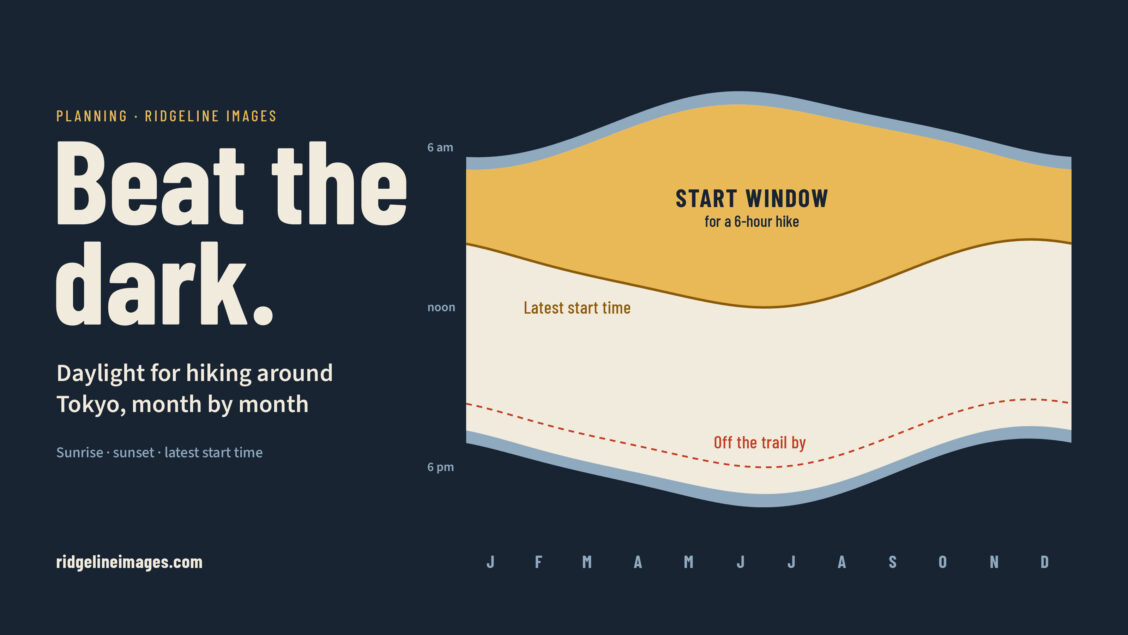
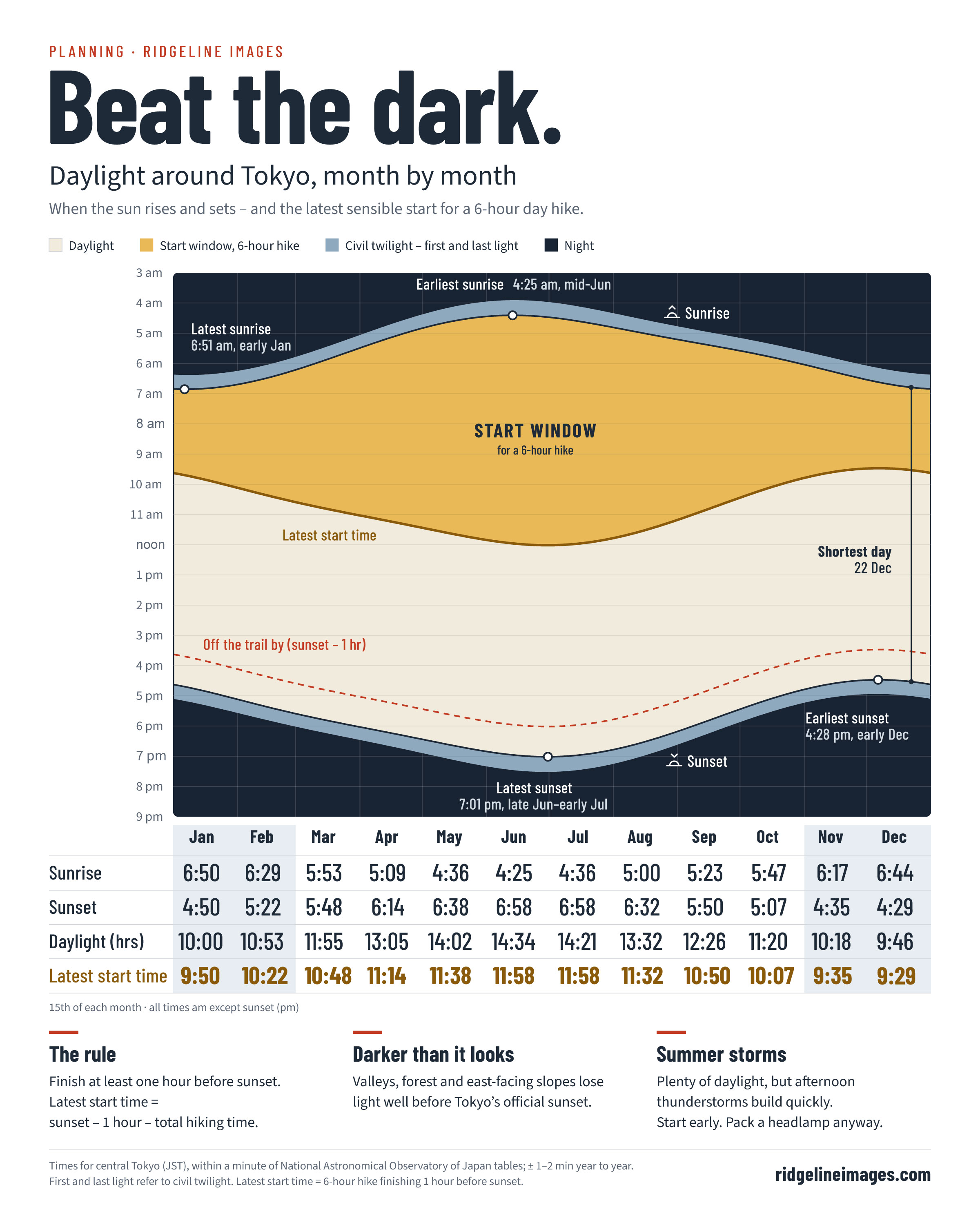
If you’re not used to planning hikes around shorter days, this chart should make things a little easier. It shows sunrise, sunset and twilight for every day of the year, plus a highlighted “start window” – the time between sunrise and the latest sensible start for a typical 6-hour day hike.
How to Read the Chart
Months run left to right, and the time of day runs from top to bottom. The pale area is daylight, the blue-grey bands on either side are twilight (first and last light), and the dark area is night.
The amber-coloured band is the start window. Its bottom edge is the latest start for a 6-hour hike if you want to be off the trail an hour before sunset. The dashed line marks that “off the trail by” time.
In June you can start as late as noon. In December the window closes at around 9:30 am – barely three hours after sunrise.
The Rule of Thumb
Aim to finish your hike at least an hour before sunset. To work out your latest start time, subtract your total hiking time from that deadline.
For the hiking time, use the course time (コースタイム) on your map and add your breaks. Course times on Japanese hiking maps don’t include rest stops, lunch or photo breaks, and these can add up quickly over a full day.
For instance, in late November, a hike with 5 hours of course time and an hour of breaks gives you a total hiking time of 6 hours. With sunset around 4:30 pm, you should aim to be off the trail by 3:30 pm, meaning your latest start is 9:30 am. Allow for the train and bus journey, and that often means leaving Tokyo before 7 am.
Why It Gets Dark Sooner in the Mountains
The times on the chart are calculated for central Tokyo, with a clear view of the horizon. Mountains don’t work like that. Valleys, forest and east-facing slopes lose direct sunlight well before the official sunset. Under a dense forest canopy, it can feel like dusk considerably earlier.
The other deadline is the bus. Some trailhead bus services are seasonal and stop running over winter. Check the timetable before you go – it may determine how much time you have on the mountain.
Why the Earliest Sunset Isn’t on the Shortest Day
You might expect the earliest sunset and the latest sunrise to fall on the winter solstice. They don’t. The earliest sunset is in early December and the latest sunrise, 6:51 am, comes in early January.
That’s because Earth’s orbit is elliptical and its axis is tilted, so solar noon drifts later through December. The afternoons start lengthening before the mornings do – good news for hikers, since it’s the end of the day that usually catches us out.
Summer Storms
In summer you have daylight to spare – the latest sunset is 7:01 pm in late June and early July. But darkness isn’t the deadline then. Afternoon thunderstorms are. On hot, humid days, aim to be off exposed ridges by early afternoon, regardless of how much daylight is left.
Always Carry a Headlamp
Carry one even on a short hike in a familiar area. Delays happen – a wrong turn, a sore knee, a missed bus – and a headlamp weighs almost nothing. Check the batteries before you leave.
About the Data
Sunrise and sunset times are calculated for central Tokyo (Japan Standard Time) and match the National Astronomical Observatory of Japan tables to within a minute. They change by only a minute or two from year to year, so the chart stays useful. First and last light refer to civil twilight, when the sun is up to 6 degrees below the horizon. The start window assumes a 6-hour hike finishing one hour before sunset – adjust for your own route and pace.
I chuckled when this appeared in my mailbox. I was on the trail in the pitch dark this am because I wanted to catch the sunrise from a peak–and then get to work.
I find YAMAP and Peakvisor (and I assume Yamarec, too) useful for giving the sunrise and sunrise times for different peaks. I think Tenkura does, too. Peakvisor will give you the azimuth of the sunrise\set, too.
Gotta echo your advice on always having a headlamp. AND, always have spare batteries.
Stay safe!