
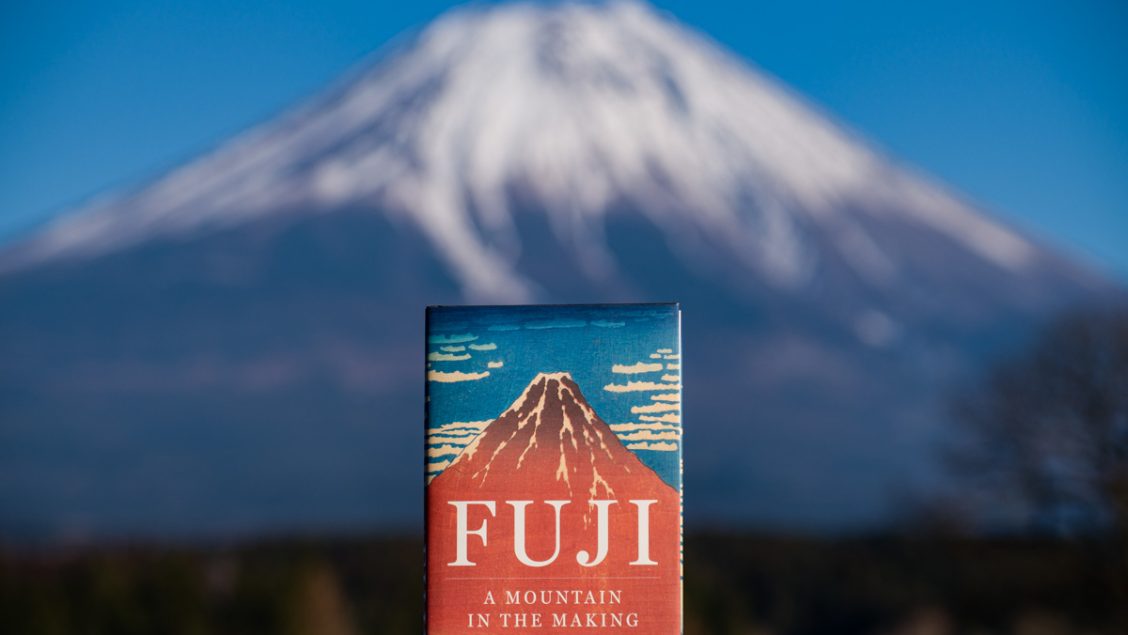
History, Belief, and the Making of Japan’s Most Enduring Symbol
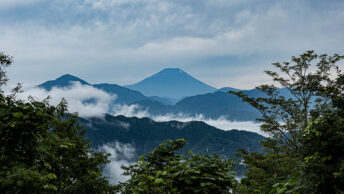
Living in Tokyo gives me the somewhat rare privilege of seeing Mount Fuji from my balcony on clear days – a view that renders the peak as a serene, distant icon. Yet, having climbed the mountain in the summer of 2000, I also know it as a physical landscape shaped by effort, weather, and time. Those two perspectives – Fuji as an everyday presence and as lived terrain – shaped my reading of Fuji: A Mountain in the Making by Professor Andrew W. Bernstein, a work that traces how the mountain itself, and the meanings attached to it, have been continually formed and re-formed over centuries.
As Project Hyakumeizan notes in his review, despite Fujisan being one of the most famous and recognisable mountains in the world, there remains a surprising lack of full-length English-language studies devoted to it. Until recently, only two such books had appeared in the past century, making Bernstein’s contribution all the more significant. That scarcity is perhaps understandable given the scale of the task: the combined footnotes and bibliography alone run to some fifty-five pages, a clear signal of the depth and ambition of the undertaking.
That ambition is evident from the outset, as the book opens by tracing Mount Fuji’s emergence from Japan’s prehistoric past and its earliest appearances in written records. Bernstein carefully layers geological history with early human encounters, showing how the mountain was once regarded less as an object of beauty and more as a volatile and unpredictable force. Through these opening chapters, Fuji appears not as a finished or inevitable symbol, but as something still very much in the process of becoming – a quality reflected even in the mountain’s name, as early written forms of “Fuji” employed characters meaning “peerless” and “timeless”, less for phonetic accuracy than to fix the mountain’s perceived qualities in language.
This process was punctuated by moments of immense geological violence. Before the Hoei eruption – which left a distinctive crater on Mount Fuji’s southeastern flank and was possibly triggered by a powerful earthquake several weeks earlier – the mountain had been relatively “well behaved” for nearly four centuries. The eruption itself proved catastrophic: communities nearby suffered severe damage, Edo was blanketed in volcanic ash, crop failures followed, and widespread famine ensued. The Tokugawa shogunate was largely unprepared for the scale and duration of the disaster.
This sense of vulnerability forms the backdrop for Bernstein’s examination of “Holy Fuji”. While the meticulous cataloging of religious sects – including the Fujiko (lay pilgrimage groups) and their – oshi (the professional priest–guides who housed and prepared them) – as well as various pilgrimage rites can at times feel dense, this chapter is essential to understanding the mountain’s spiritual evolution. Here we see the widespread construction of “mini-Fujis”, or Fujizuka, which culminated in a substantial artificial mound on the grounds of Waseda University. These structures allowed those unable to undertake the arduous journey themselves – including women, who were historically prohibited from climbing beyond the lower slopes to experience a condensed, symbolic ascent.
Without the modern convenience of the Fuji–Subaru Line’s fifth station (which only opened in 1964), Tokugawa-period climbers experienced the mountain in a far more immersive way. They began their ascent from the foothills, performing ritual purifications at waterfalls before eventually reaching the summit crater. Much like tourism today, these pilgrims were a vital source of income for surrounding communities.
The establishment of Edo by Tokugawa Ieyasu brought Mount Fuji decisively into Japan’s cultural imagination. The mountain became deeply embedded in poetry and visual art, appearing in the works of figures such as Matsuo Basho, Katsushika Hokusai, and Utagawa Hiroshige, as well as in countless everyday motifs. Fuji also entered popular belief as one of the auspicious images to dream of at the start of the New Year (the hatsuyume), cementing its role as both a cultural symbol and a national emblem. Bernstein shows how this process intensified towards the end of the Tokugawa period and accelerated as Japan emerged from sakoku and re-engaged with the outside world.
The earliest foreign climbers were granted access to Mount Fuji only reluctantly, provoking strong opposition from those who viewed their ascent as a violation of the mountain’s sacred character. After considerable arm-twisting – and accompanied by a substantial local entourage – the first to make the climb was Rutherford Alcock, the British consul general, in September 1860. His ascent paved the way for others, including Lady Fanny Parkes, the wife of the British Minister to Japan, who in 1867 became the first non-Japanese woman to reach the summit. The first woman to do so outright was Tatsu Takayama, who climbed the mountain disguised as a man in 1832, openly defying nyonin kinsei, the traditional ban on women entering sacred mountains.
One particularly compelling side story introduces the pioneering meteorological duo Nonaka Itaru and his wife Nonaka Chiyoko, who attempted to endure the brutal winter atop Mount Fuji in the name of scientific observation. Roughly two months into the ordeal, the mountain proved stronger than human resolve, forcing the couple to abandon the summit. Their severely weakened bodies were carried back down to safety, and their story of survival captured the public imagination, turning them into national celebrities.
By the late nineteenth century, climbing Mount Fuji was no longer restricted to the wealthy and well-connected. Aided by expanding railway networks, it became an early form of mass tourism, with even schoolchildren reaching the summit. Over time, however, Japan’s natural beauty – and Mount Fuji in particular – was increasingly mobilised for ideological ends, used to foster patriotic sentiment as the nation grew more militaristic following the First Sino-Japanese War and the incorporation of Taiwan into the empire. By the early 1940s, climbing numbers surged as Fuji was recast as a site of collective identity and obligation. After World War II, it was also used to perpetuate a fantasy of a homogenous Japan.
The mountain also became a battleground over ownership of its summit. The National Parks Association of Japan argued that it should belong to the Japanese people as a whole, while Fujisan Hongu Sengen Taisha maintained that the summit had historically belonged to the shrine. This legal and ideological dispute dragged on for decades until Japan’s Supreme Court ultimately ruled in favour of the shrine, recognising it as the rightful custodian.
In the final chapters, Bernstein turns to several pivotal economies that developed around Mount Fuji. These include the silk industry – Japan’s primary export until 1940 – as well as tea and paper manufacturing, the latter two of which continue to play a role in the local economy today. Pulp and paper manufacturing have not been without their downsides, particularly in terms of toxic emissions and heavy water use. Anyone who has hiked the surrounding trails in Yamanashi Prefecture will also be familiar with a more jarring modern presence: the sound of live-ammunition fire echoing from the roughly 34,000-acre training grounds of North Fuji Maneuver Area and the East Fuji Maneuver Area at the mountain’s foothills.
The book concludes with Mount Fuji’s designation as a UNESCO World Cultural Heritage site in 2013 – an accolade that almost failed to make it past the starting gate due to illegal dumping, vehicle pollution, and a distinct lack of biotoilets. In the years leading up to the designation, annual climber numbers swelled to more than 300,000, a burden arguably greater than any single mountain should be expected to bear. More recently, those numbers have begun to decline as authorities introduced entry fees and imposed daily limits on climbers using the Yoshida Trail, signalling a tentative shift towards sustainability.
One area where the book does struggle is in the reproduction of its grayscale imagery, including some of the author’s own photographs. A particularly disappointing example is the scroll depicting Prince Shotoku flying over Mount Fuji, reproduced so darkly that much of its detail is lost. It would have been far better served by inclusion among the colour plates at the centre of the book – something worth considering should the work ever be reprinted.
This shortcoming aside, Fuji: A Mountain in the Making is an impressive and deeply researched study that does rare justice to a mountain that continues to evolve, shaping – for better or worse – the lives and imaginations of those fortunate enough to witness its presence.
Fuji: A Mountain in the Making
by Andrew W. Bernstein
316 pages. Princeton University Press. ¥5,944.
Publication date: September 23, 2025
Available for purchase here.

It’s great to see another review of Prof. Bernstein’s book, and one that brings out additional insights and angles. Like the mountain itself, there’s a lot to this book, and it’s a challenge to cover all aspects in one brief overview. Among others, one particular paragraph of your excellent and appreciative review caught my eye:
“Without the modern convenience of the Fuji–Subaru Line’s fifth station (which only opened in 1964), Tokugawa-period climbers experienced the mountain in a far more immersive way. They began their ascent from the foothills … ”
Now there’s an insight that the hiking/mountaineering community could get behind – namely, promoting the trails that climb the mountain from its base, and encouraging their restoration and use. You know, it could even start with a series on a hiking/mountaineering blog … : )
Thanks for reading, PH. You’re absolutely right – the book packs in quite a lot, and this review barely scratches the surface. With respect to your point in Chapter 9, “World Heritage Fuji”, I was particularly taken by this line:
“Efforts have been made to revitalize trails that Fujiko pilgrims trod from the base of the mountain to the fifth station, but it is unlikely that more than a small percentage of visitors to Fuji will ever walk them”.
That, along with your comment, may well have provided the spark to go and check out a hike to the fifth station via one of the old pilgrim trails – perhaps the route past the Hitoana lava cave.
Some crazy people do attempt what is known as a Zero Fuji – I think it’s hiking it either from the sea, or from 0 elevation (unless that’s the same thing?) I know one hiker who decided to save his 100th hyakumeizan as Mt Fuji, and did it as a zero fuji, which is quite the feat.
Also related is the Sea to Summit events (https://www.seatosummit.jp/menu116/) which is a sort-of triathlon where people start at the water and then kayak, cycle and hike their way up to the peak.